


Transport of Dangerous Goods (TDG) in Tunnels: Rules, Limits, and Obligations
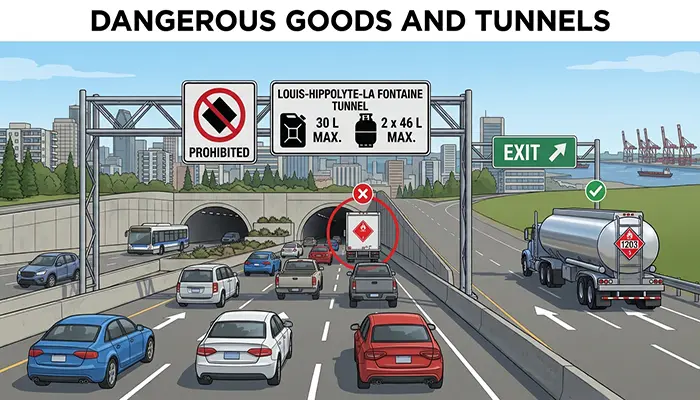
Why Are TDG Regulations Stricter in Tunnels?
A tunnel is a closed space. In a fire, smoke accumulates instead of dispersing, users have limited escape routes, and firefighters can only access the scene from both ends. An incident that would remain contained on an open highway can quickly escalate into a catastrophe inside a tunnel.
For this reason, several Canadian tunnels, including five in Quebec, are subject to Transportation of Dangerous Goods (TDG) regulations that are far stricter than standard rules. These do not apply solely to tanker trucks: they also apply to contractors transporting a few propane cylinders or recreational vehicle owners.
What Are the Rules for Transporting Dangerous Goods in Tunnels Across Canada?
The Transportation of Dangerous Goods Act and Regulations (TDGA and TDGR) set the baseline rules nationwide: classification, shipping documents, placards, and training. However, they do not provide a centralized list of restricted tunnels. Instead, provinces or facility operators establish restrictions on a tunnel-by-tunnel basis:
- Quebec: Five tunnels and bridge-tunnels are regulated by law.
- British Columbia: The George Massey Tunnel and Cassiar Connector prohibit vehicles required to display placards.
- Ontario: The operator of the Detroit-Windsor Tunnel bans vehicles carrying hazardous or radioactive materials.
The core principle remains consistent: any vehicle required to display hazard placards must avoid restricted tunnels. Because exact details vary between facilities, drivers must verify the rules for every tunnel along their route—especially when travelling interprovincially or toward the border.
Which 5 Tunnels Are Subject to TDG Restrictions in Quebec?
- Montreal: Louis-Hippolyte-La Fontaine Bridge-Tunnel, Ville-Marie Tunnel, and Viger Tunnel
- Quebec City: Joseph-Samson Bridge-Tunnel
- Beauharnois: Melocheville Tunnel
Other tunnels in Quebec are not subject to these specific restrictions, though general TDG regulations still apply.
How Do You Identify a Dangerous Goods Prohibition Sign?
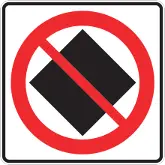
The "Access prohibited to dangerous goods carriers" sign indicates public roads and tunnels off-limits to drivers transporting dangerous goods covered under Section 43 of the Regulation respecting the transport of dangerous goods.
It is posted on approaches to restricted structures, giving drivers enough time to exit the main highway. Upon seeing this sign, drivers of restricted vehicles must not enter the tunnel and must take a bypass route. Planning this detour prior to departure is critical, as urban tunnel approaches offer limited exit opportunities.
Which Dangerous Goods Placards and Classes Are Prohibited in Tunnels?
Here they are at a glance!
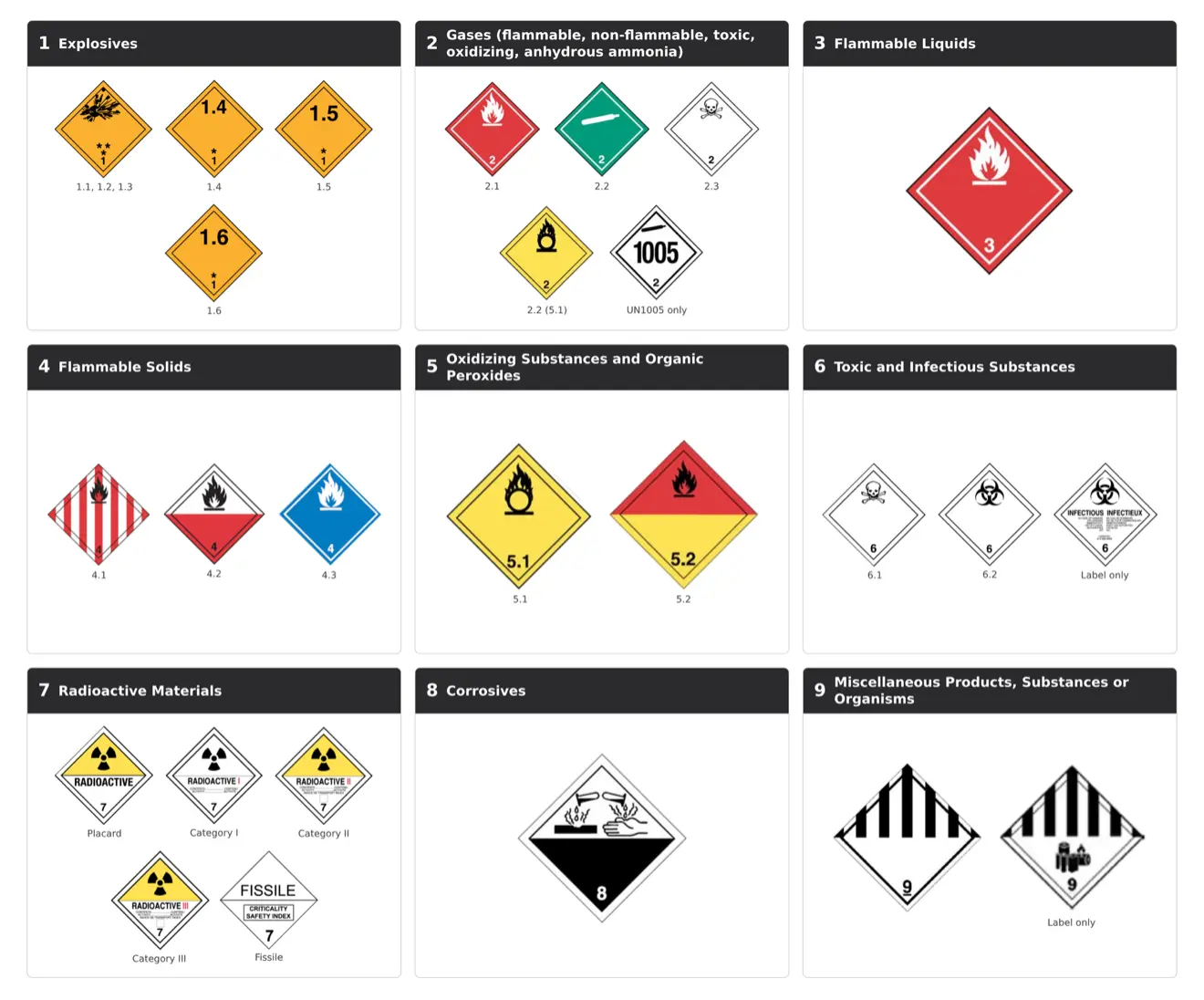
If your vehicle is required to display any of these hazard placards, it cannot enter. Class 9 is the sole exception: in restricted Quebec tunnels, a vehicle displaying only Class 9 placards is permitted to enter. The restriction covers all other classes and divisions from 1 through 8, including Class 3 flammable liquids (gasoline, diesel, solvents), which are the most common on the road.
Unplacarded Vehicles: What Are the Maximum Allowed Quantities Per Tunnel?
Even unplacarded vehicles driven by private citizens must adhere to maximum allowable quantities when passing through restricted Quebec tunnels. Warning signs reiterate these limits on the approach to each structure.
The "Dangerous goods in tunnels" sign reminds road users of specific hazardous materials and maximum quantities allowed in a tunnel pursuant to Section 43 of the Regulation respecting the transport of dangerous goods.
The maximum permitted limits per vehicle are:
- Flammable liquids (gasoline, diesel, kerosene, solvents): 30 L total across all containers combined;
- Flammable gases (propane, butane, acetylene) or oxidizers (such as oxygen): 2 cylinders of no more than 46 L capacity each.
Exceeding these limits requires taking a bypass route, even if the vehicle does not require placards.
TDG in Tunnels: What Are the Responsibilities of the Consignor and the Carrier?
- The consignor classifies the materials, packages and labels the goods, prepares the shipping document, and provides placards to the carrier when required. Without this information, the carrier cannot determine whether a tunnel is off-limits.
- The carrier and driver display the required placards, verify the quantities transported (including small containers and cylinders), and plan a compliant detour before departure.
- Anyone handling, offering for transport, or transporting dangerous goods must hold a valid TDG training certificate (valid for 36 months in road transport) or work under the direct supervision of a certified individual. The employer issues this certificate and must present it upon request.
Fines and Penalties: What Are the Consequences of a TDG Violation in a Tunnel?
A vehicle carrying dangerous goods that unlawfully enters a restricted tunnel poses a severe hazard to other road users and emergency responders. Legally, both the company and the driver face:
- Fines under the Highway Safety Code and the Regulation respecting the transport of dangerous goods, levied against the carrier, consignor, or both depending on the offense;
- Negative impacts on the company's safety record with the Commission des transports du Québec (PEVL score);
- Substantial civil liability in the event of an accident, alongside potential criminal prosecution if injuries or fatalities occur.
Kalium Solutions: Your Partner for TDG Compliance and Training in Canada
Operating legally through tunnels requires accurate product classification, precise volume calculations, and well-trained personnel. Kalium Solutions assists consignors and carriers at every step:
- TDG Training tailored for consignors, handlers, receivers, and road carriers covering Quebec tunnel restrictions—available on-site, in-class, or online.
- Issuance of training certificates required by regulatory authorities.
- Product classification and validation of shipping documents.
- Compliance audits for internal TDG procedures.
Are your teams familiar with the rules governing tunnel transport? Contact the experts at Kalium Solutions today to schedule TDG training or verify your compliance status.
Discover our training programs
References
- Government of Quebec, Transporting commonly used dangerous goods: https://www.quebec.ca/transports/circulation-securite-routiere/transporter-matieres-dangereuses-usage-courant
- Ministry of Transport and Sustainable Mobility, Restrictions on the transport of dangerous goods in tunnels and bridge-tunnels brochure: https://www.transports.gouv.qc.ca/fr/entreprises-partenaires/ent-camionnage/Documents/depliant-TMD.pdf
- Government of Quebec, Major rehabilitation of the Ville-Marie and Viger tunnels: https://www.quebec.ca/transports/infrastructures-projets/projets/projets-routiers/montreal/refection-majeure-tunnels-ville-marie-viger
- British Columbia, Tunnel Transportation of Dangerous Goods Regulation (B.C. Reg. 275/2006): https://free.bcpublications.ca/civix/document/id/complete/statreg/275_2006
- Detroit Windsor Tunnel, FAQ: https://www.dwtunnel.com/faqs/
- Government of Canada, Transportation of Dangerous Goods Act, 1992 and Transportation of Dangerous Goods Regulations (SOR/2001-286): https://laws-lois.justice.gc.ca/eng/regulations/SOR-2001-286/
- Government of Quebec, Regulation respecting the transport of dangerous goods (CQLR c C-24.2, r 43): https://www.legisquebec.gouv.qc.ca/en/document/rc/C-24.2,%20r.%2043


Design, programming and hosting by VisionW3.com

