


Environmental Claims: How to Ensure Label Compliance and Avoid Greenwashing
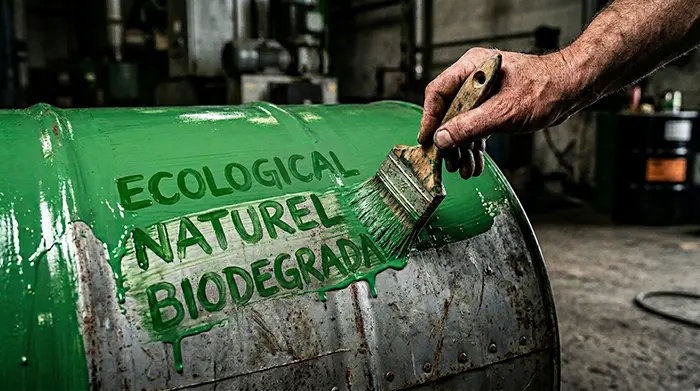
Since June 20, 2024, Canada's Competition Act requires businesses to substantiate an environmental claim before publishing it, not after a complaint is filed. The burden of proof rests on the business making the claim. For a chemical product labelled “green,” “biodegradable,” or “eco-friendly,” this concretely changes what needs to be on hand before the label goes to print.
What Is Greenwashing Under the Law?
Greenwashing refers to a claim about the environmental benefits of a product or business that is not backed by sufficient evidence. This wasn't entirely absent from the law before 2024, but two amendments to the Competition Act created obligations specific to environmental claims, with a more explicit burden of proof and higher penalties.
What Has Canada's Competition Act Said Since June 2024?
Bill C-59, which received royal assent on June 20, 2024, added two distinct paragraphs to section 74.01(1) of the Competition Act, each with its own requirements and its own evolution since. Paragraph 74.01(1)(b.1) deals with claims about a product, while paragraph 74.01(1)(b.2) deals with claims about a business.
Product Environmental Claims
Covers claims about the environmental benefits of a specific product, for example “biodegradable” or “recyclable” on a label. Requires an “adequate and proper test” conducted before the claim is made. In force since June 20, 2024, unchanged since. The private right of action, in force since June 20, 2025, applies fully to this type of claim: a competitor or public interest organization can bring an application directly before the Competition Tribunal, with leave, without going through a Bureau complaint.
Business Environmental Claims
Covers claims about the environmental performance of a business or its activity itself, for example a “carbon neutral” or “net zero” target. In force since June 20, 2024, but amended twice by Bill C-15, which received royal assent on March 26, 2026:
1. The substantiation required. The original text required substantiation “in accordance with internationally recognized methodology.” This requirement has been removed; the standard is now “adequate and proper substantiation,” aligned with the wording of 74.01(1)(b.1).
2. The private right of action. Removed specifically for this type of claim. Since March 2026, only the Commissioner of Competition can pursue a claim covered by 74.01(1)(b.2); a competitor or public interest organization can no longer apply directly to the Tribunal for this specific case.
If you've read an explanation of this law from before 2026, check that it reflects this double update.
Administrative Monetary Penalties
The administrative monetary penalties set out in section 74.1 are substantial:
- For an individual: the greater of $750,000 (first violation) or $1,000,000 (subsequent violation), or three times the value of the benefit derived from the practice.
- For a business: the greater of $10,000,000 (first violation) or $15,000,000 (subsequent violation), three times the value of the benefit derived, or 3% of worldwide gross revenues if the benefit cannot be determined.
A due diligence defence exists, but it requires having documented evidence of the claim already on hand, not assembled after the fact.
Standards and Guidelines: ISO 14021 and Bureau Expectations
The ISO 14021 standard (self-declared environmental claims, known as “Type II”) has long served as a reference through the joint guide from the Competition Bureau and the Canadian Standards Association. On June 5, 2025, the Bureau published new enforcement guidelines specific to environmental claims following the 2024 amendments. The version currently in force is ISO 14021:2016, with Amendment 1:2021, which added “carbon neutral” and “carbon footprint” claims; a revision is in development but has not yet been published.
The standard explicitly prohibits generic terms that nothing can really prove: “environmentally friendly,” “green,” “nature's friend,” or “ozone friendly” are considered too vague to be substantiated, regardless of the intent behind the claim. A label that simply says “green” or “eco-friendly,” without specifying which particular aspect the benefit relates to, is exactly the kind of claim the standard targets.
For the terms it does permit, such as “recyclable,” “compostable,” or “biodegradable,” ISO 14021 imposes precise conditions rather than free use. A “recyclable” claim requires that collection and processing infrastructure actually exist where the product is sold, not just in theory, exactly what cost Keurig Canada $3 million (see the example below). A “biodegradable” claim requires specifying the degradation mechanism and rate under realistic conditions, not just the assertion of the term itself.
Limits to Know Before Making a Claim
The June 5, 2025 guidelines set out six principles. Two apply directly to labelling a chemical product.
Comparison specificity. A comparative claim (“greener than,” “less polluting than”) must specify exactly what is being compared and the extent of the difference. A vague comparison, even one that's broadly true, is treated as a risk.
The full life cycle. A term like “eco-friendly” implies a benefit across the product's entire life cycle: sourcing, manufacturing, packaging, transport, use, and disposal. A recyclable container doesn't make an “eco-friendly” claim true if the formulation itself pollutes during use. The Bureau's principle: “when in doubt, be specific.”
Real-World Guidance Examples
| Claim | Verdict | Why |
|---|---|---|
| Bath bombs, “100% post-consumer cardboard” | Non-compliant | False: the packaging was made of virgin fibre, not recycled material. Covered by the general prohibition on false or misleading representations. |
| Fuel additive claim copied from a competitor | Non-compliant | Does not meet the testing requirement: no independent test conducted by the business itself. |
| “Microplastic-free” sweater | Non-compliant | Tested under conditions that did not replicate real washing machine use: testing deemed inadequate. |
| “Carbon neutral by 2050” | Non-compliant | Good intentions stated, but no concrete plan or methodology: insufficient substantiation. |
| 50% reduction in nitrogen runoff (agricultural operation) | Compliant | Supported by ISO 5667-1 and ISO 5667-6 measurement standards, a recognized methodology. |
| Electrification of a delivery fleet | Compliant | Supported by the GHG Protocol for Project Accounting, a recognized methodology. |
| “20% recycled content” | Out of scope | Not a claim covered by the new provisions; requires no testing or particular substantiation, but must remain factually accurate. |
Case Study: The Keurig Canada Decision
In January 2022, Keurig Canada paid a $3 million penalty over claims about the recyclability of its K-Cup pods. The problem, specifically: ISO 14021 requires that a product labelled “recyclable” can actually be collected and processed, not just in theory, yet K-Cups were not accepted in municipal recycling programs outside Quebec and British Columbia, which made the claim misleading elsewhere in the country. This case predates the 2024 amendments and was decided under the existing general provision on false or misleading representations, not under the new paragraphs b.1 or b.2. It nonetheless illustrates the type of claim that draws the Bureau's attention, now with a more explicit burden of proof on the business.
Key Takeaways for Chemical Product Labeling
- Document the test or substantiation before publishing the claim, not after a complaint.
- The burden of proof rests on the business making the claim, not on whoever challenges it.
- A private right of action has been possible since June 2025 for a claim about a specific product or a general misleading representation, but no longer for a claim about the business itself since March 2026.
- If your evidence file for a claim about your business (74.01(1)(b.2), such as “carbon neutral” or “net zero”) was built before March 2026 around “internationally recognized methodology,” that requirement is no longer required as of March 26, 2026. The standard is now adequate and proper substantiation, as with a product. Documentation already built on the old standard remains valid, but it is no longer mandatory for substantiating a new claim.
Need Help Substantiating Your Environmental Claims?
Kalium Solutions validates the compliance of your chemical product labels under the CCCR, including compliance validation under the Competition Act.
Talk to an expert chemist before publishing an environmental claim on your products:


Design, programming and hosting by VisionW3.com

