


Why Excel and Paper Binders Are No Longer Enough to Manage Your SDS
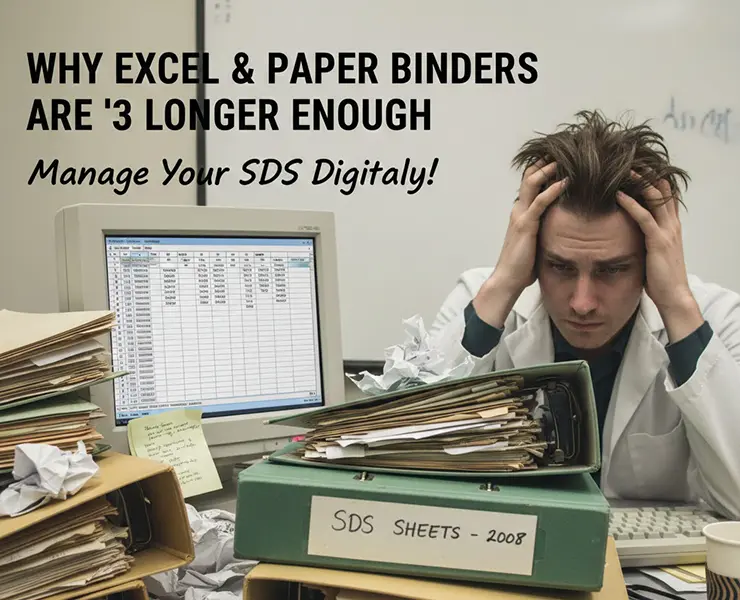
In the world of Occupational Health and Safety (OHS), there is a massive gap between being "compliant on paper" and being "truly safe on the shop floor." For many companies, Safety Data Sheet (SDS) management still relies on two pillars inherited from the 90s: Excel spreadsheets and heavy yellow three-ring binders.
However, with the evolution of WHMIS standards and the rapid pace of today’s industrial cycles, these methods are not just archaic—they have become dangerous. Here is a deep dive into why you must break the manual cycle and step into the Kalium Solutions era.
1. The Myth of the Paper Binder: A Weak Link in Hiding
The paper binder is often seen as the ultimate "backup." We tell ourselves: "If the network goes down, the binder will be there." But in the reality of the field, this binder is a decaying organism.
The Illusion of Maintenance
Setting up a binder with 200 sheets requires colossal energy: printing, hole-punching, alphabetical filing, and inserting dividers. We finish this task with a sense of satisfaction. Yet, by the very next day, it begins to become obsolete. Who will take the 15 hours required each month to check if the supplier of an industrial cleaner has modified Section 9 of its SDS? No one.
The "Nomadic" SDS: The Danger of the Empty Page
This is the nightmare scenario our clients report most often. An incident occurs: an employee gets a chemical splash to the face. A colleague runs to get the binder, finds the SDS, and rips it out (because time is of the essence) to show it to first responders or take it to the eye-wash station.
In the heat of the moment, that SDS ends up wet, crumpled, or simply forgotten on a counter. The result? The next time an accident occurs with that same product, the binder is empty. Staff desperately search for information that is no longer there. The paper binder is not a reliable archive; it is a system that self-destructs with every use.
2. Human Expertise Behind the Technology: The Rigor of Chemists
We often hear that software "automates" compliance. At Kalium Solutions, we believe that automation without expertise is a risk in itself. This is where we radically stand out from a simple Excel spreadsheet.
Why Excel Lies to You
An Excel spreadsheet cannot read the scientific content of a sheet. It merely stores a date that you entered manually. If you misinterpreted a classification during entry, the error will remain there until the next inspection or, worse, until the next accident.
The Power of Seasoned Chemists
The transition to WHMIS requires a fine understanding of toxicology and physico-chemical properties. When you use Kalium Solutions, you aren’t just buying software; you are gaining access to a team of seasoned chemists.
- Every time an SDS is updated by a supplier, our experts analyze it thoroughly.
- We don’t just replace one PDF with another; we extract the data, validate the classifications, and ensure that hazards are correctly translated and interpreted according to the strictest Canadian standards.
It is this human validation that transforms a simple database into a legal and safety shield for your company.
3. WHMIS 2015: Why Manual Compliance is a Minefield
Since global harmonization (GHS), WHMIS 2015 has transformed compliance requirements in Canada. It is no longer just a matter of having "a sheet in a file"; it is a matter of constant technical precision that paper simply cannot provide.
The Complex Evolution of Classifications
WHMIS 2015 introduced much more nuanced hazard classes and specific pictograms that are not interchangeable.
- The Risk of Manual Mode: A supplier may decide to reclassify a product as a "Respiratory Sensitizer" following new scientific studies. If you manage this manually, you won’t know until your next annual audit (if it even happens).
- The Expert Solution: This is where the Kalium Solutions chemistry team steps in. By actively monitoring updates, we ensure your inventories reflect current scientific reality, not that of three years ago.
Workplace Labeling: A Legal Obligation
WHMIS is very clear: any container decanted or used in the workplace must have a compliant label. This label must include critical information from the SDS (product name, precautionary statements and a reference to the SDS).
- The Burden of Paper: Trying to manually copy information from a paper SDS onto a label is a perfect recipe for human error. One forgotten piece of information, and you are in violation during a regulatory inspection.
- Safety Through Automation: Kalium Solutions software eliminates this risk by generating workplace labels that pull directly from the validated database. The label is precise, legible, and includes the famous QR code for total access to the source information.
4. Revolutionary Accessibility: The QR Code at the Heart of the Action
The greatest challenge in chemical safety is reducing the time between "I have a question" and "I have the answer." Kalium Solutions eliminates all unnecessary steps.
The Smart Binder
We have reinvented the physical support. The Kalium Solutions binder no longer contains hundreds of volatile pages. Instead, it contains clear indexes equipped with QR codes.
- The employee no longer needs to pull out a sheet. They scan the code with their mobile device or a company tablet.
- The SDS appears instantly. The original information stays in the binder, accessible forever, without ever getting lost.
Information Stuck to the Hazard
But we went further. Kalium Solutions software generates workplace labels that also include this famous QR code. Imagine the scene: a worker is handling a drum in a remote corner of the warehouse. He has a doubt about which gloves to use. Instead of walking 5 minutes to the supervisor's office to consult a binder or computer, he scans the label directly on the drum.
In two seconds, the SDS validated by our chemists is in his hand. This is what we call safety at the point of use.
5. The Hidden Costs of Manual Mode
If you are still hesitating to drop your Excel file, do a quick calculation of the "Cost of Inaction" (COI):
- Administrative Time: Calculate the hourly wage of the person responsible for OHS. Multiply it by the number of hours spent searching for SDSs, printing them, and following up with suppliers. This figure often significantly exceeds the annual cost of a Kalium Solutions license.
- Non-Compliance Risk: A single fine from a regulatory body for deficient WHMIS management can cost tens of thousands of dollars.
- Productivity: How much time do your employees lose looking for information instead of producing?
Conclusion: Toward a Modern Safety Culture
Excel is a bookkeeping tool. Paper is a reading medium. Neither is a management system for human life.
By adopting Kalium Solutions, you are doing much more than just becoming compliant. You are showing your employees that their safety is an absolute priority. You replace confusion with clarity, and uncertainty with the expertise of our chemists.
Don't let a missing page or a faulty Excel cell define your OHS record. Move to a system where information is always where it’s needed, when it’s needed.
Switch to automated management. Avoid errors and save precious time.
Are you ready to see the difference for yourself? Our experts are here to show you how Kalium Solutions can transform your hazardous materials management into a fluid, safe, and 100% compliant process.
👉 Request a demo of our software and discover the future of the SDS binder.


Design, programming and hosting by VisionW3.com

