


How to Read and Interpret a Safety Data Sheet (SDS) in 5 Minutes
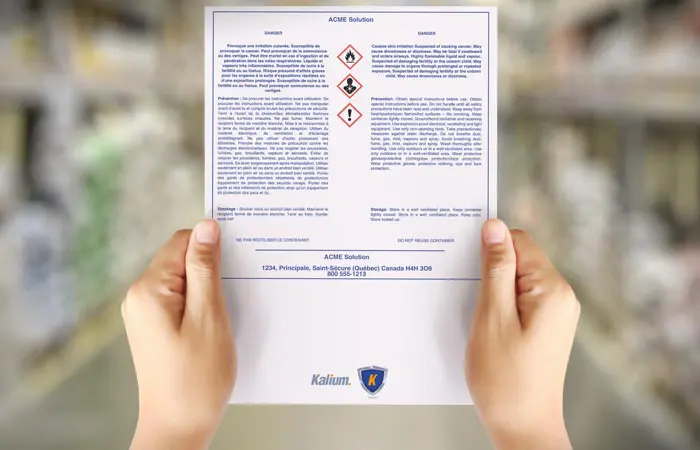
As an OHS manager or supervisor, you know that the Safety Data Sheet (SDS) is much more than a simple legal obligation: it is your workers' life insurance. However, with its 16 dense sections, it can often seem overwhelming.
It is crucial to understand that WHMIS (Workplace Hazardous Materials Information System) in Canada is now harmonized with the GHS (Globally Harmonized System). The GHS stems from UN recommendations to standardize classification criteria and SDS structures worldwide. Here is how to navigate this international document to ensure seamless local safety.
The Origins of the Document: From GHS to WHMIS
Why do all SDSs look the same today? Because Canada adopted UN standards. The transition to WHMIS 2015 (and its recent updates) marked the end of disparate safety data sheets. The goal of the GHS is simple: "One hazard, one signal, one message."
Whether your product comes from Germany, China, or Canada, it must follow the same 16-section structure. This predictability is your best ally in an emergency. However, Canada imposes strict nuances (such as bilingualism and Physical Hazards Not Otherwise Classified), which can make compliance complex for businesses.
The goal is not to memorize everything, but to know where to find critical information. A misinterpretation of a pictogram or a storage instruction can lead to serious accidents.
The "Quick Scan": Where to Look First?
If you only have 60 seconds during a spill or exposure, don't read the whole thing. The GHS was designed so that vital information is placed strategically:
- Section 2: Hazard Identification (This is where you find pictograms, signal words, and hazard statements).
- Section 4: First-Aid Measures (Immediate first aid steps).
- Section 8: Exposure Controls/Personal Protection (What PPE to wear).
Detailed Guide to the 16 Sections (UN/GHS Standard)
For rigorous management, here is the breakdown of the information blocks you will systematically find.
| Information Block | Sections | What to Remember |
| Immediate Emergency | 1 to 4 | Product identification, hazard classification (GHS), composition, and first aid. |
| Emergency Measures | 5 and 6 | Appropriate extinguishing media (fire) and containment procedures (spills). |
| Prevention & Storage | 7 and 8 | Safe handling, ventilation, and Personal Protective Equipment (PPE). |
| Technical Data | 9 to 12 | Physico-chemical properties (pH, flash point), stability, and toxicology. |
| Transport & Legal | 13 to 16 | Waste disposal, transport (TDG), and specific regulatory information. |
Critical Sections Often Overlooked by Supervisors
- Section 9 (Physical and Chemical Properties): Do not ignore this. The flash point tells you the temperature at which the product releases enough vapor to ignite near a flame, while the auto-ignition temperature reveals the point at which the ambient heat alone becomes a danger. The pH will warn you of immediate chemical burn risks.
- Section 10 (Stability and Reactivity): This is where you prevent explosions due to poor storage. It specifies if the product becomes unstable under certain conditions or reacts violently with water or air.
- Section 11 (Toxicological Information): Essential for understanding chronic effects, such as respiratory sensitization or long-term toxicity (cancer, mutagenesis).
Kalium Solutions: Expertise Behind Compliance
Chemical management doesn't end with reading a sheet. You must maintain a living inventory and documents compliant with North American laws. This is where Kalium Solutions becomes your strategic partner.
SDS Management Software for Lease
Paper management is outdated and risky. We offer SDS management software in SaaS mode (lease). Our solutions provide:
- Instant Access: Employees can access sheets via mobile or workstations.
- Rigorous Version Management: When a new SDS is submitted into the system, the inventory updates to ensure you are always working with the most recent information.
- Label Printing: Print WHMIS and workplace labels directly from the SDS data, ensuring your secondary containers are always properly identified.
- Simplified Search: Search by pictogram or chemical hazard.
Turnkey Service: SDS Authoring by Our Chemists
If you manufacture your own blends, you are obligated to provide a compliant SDS. Our team of chemists authors your sheets by strictly applying WHMIS (Canada) and HCS 2024 (USA) criteria.
- North American Compliance: Unlike generic GHS authoring, our SDSs respect specific Canadian and American requirements (often stricter than the UN baseline), including mandatory bilingualism and hazard classes specific to our jurisdictions.
- Scientific Rigor: We analyze your formulas to ensure accurate and safe classification.
- Peace of Mind: Delegate technical responsibility to chemistry professionals.
3 Expert Tips for Floor Supervisors
- Tip 1: Verify the Validity and Source of Your Sheets
In Canada, while the strict 3-year update rule has been eased, the obligation to have up-to-date information remains. Ensure your sheets mention compliance with the Hazardous Products Regulations (HPR). If you see terms like "Material Safety Data Sheet" (MSDS) or old circular symbols (pre-2015), the sheet is obsolete. Periodic review is essential: if hazard classifications evolve, your protection must follow. - Tip 2: The Incompatibility Test (Sections 7 and 10)
Don't rely solely on the label. Consult Section 10. If you store two products that react together (e.g., an acid and a strong base) side by side, you are creating a ticking time bomb. Use the SDS to map your warehouse safely and avoid dangerous reactions. - Tip 3: The "Pictogram Drill" and Continuous Training
WHMIS is not static. Take advantage of floor walks to ask a direct question: "If this product with the gas cylinder pictogram leaks, what is the immediate evacuation procedure?" Validate the answer using Section 6. Kalium Solutions can support you with custom WHMIS training to ensure your teams stay ahead of regulatory changes.
Conclusion: Safety Begins with Precision
The SDS is the bridge between chemical science and workplace safety. Thanks to the global harmonization of the GHS, we now all speak the same safety language. However, managing these documents remains a significant challenge for any compliance-conscious company.
An SDS is only useful if it is accessible, up-to-date, and understood by those handling the product. Don't let paperwork compromise your team's safety.
📢 Take Action with Kalium Solutions
Does chemical management seem complex? Let us simplify your life:
Contact us today for a free consultation
Looking to train your team leads? Register them for our training: Interpreting SDS and WHMIS Compliance.


Design, programming and hosting by VisionW3.com

