

Understanding VOCs: Impact, Health and Regulation in Canada
VOCs: These invisible pollutants that live with us
When we think of air pollution, we often imagine large factory chimneys or exhaust pipes in traffic jams. Yet, the air we breathe inside our homes, offices and schools is sometimes more polluted than the air outside. The main culprits? VOCs, or Volatile Organic Compounds.
What is a VOC, exactly?
Behind this technical term lies a simple reality: VOCs are chemical substances containing carbon and hydrogen. Their particularity lies in their "volatile" nature: they evaporate very easily at room temperature.
Unlike dust, they do not settle on the ground; they mix with the air in gaseous form. In fact, they are often the ones responsible for the "smell of new" furniture or the characteristic odor of a freshly painted room.
Why should we be concerned about VOCs ?
These substances are not just odors. Once released into the air, they easily enter our respiratory system. Depending on the duration of exposure and concentration, the effects can vary:
Health impacts of VOCs
Since we spend nearly 90% of our time indoors, the constant inhalation of these gases is not without consequences. The effects of VOCs on our bodies depend on two factors: the toxicity of the compound and the duration of exposure.
Short-term (Immediate effects)
Often mistaken for fatigue or seasonal allergies, symptoms can include:
- Mucous membrane irritations: Itchy eyes, stuffy nose, or sore throat.
- Neurological disorders: Frequent headaches, dizziness, and unexplained fatigue.
- Skin reactions: Itching or rashing for the most sensitive people.
Long-term (Chronic effects)
Prolonged exposure, even at low doses, can be more insidious:
- Worsening asthma: VOCs are major triggers of attacks in children and people with asthma.
- Systemic toxicity: Certain compounds are classified as carcinogens or endocrine disruptors, which can affect the liver, kidneys, or central nervous system over several years.
Summary of VOC sources and effects
To help you identify the risks in your home, here is a summary table:
|
Product Type |
Chemical compound |
Main effect |
|---|---|---|
|
Cleaning products & candles |
Limonene / Pinene |
Asthma or rash trigger |
|
New furniture & pressed wood |
Formaldehyde |
Irritation of the respiratory tract |
|
Paints, Glues & Solvents |
Toluene / Xylene |
Headaches and nausea |
|
Dry Cleaning & Tobacco |
Benzene / Perchloroethylene |
Serious chronic risks |
Did you know? Our homes are full of sources of VOCs: from cleaning products to home fragrances to the adhesives used in particleboard furniture. Understanding their origin is the first step to regain control over the air quality in your home.
The Environmental impacts of VOCs
The effects of VOCs do not stop at our doorstep. When they escape outdoors (through ventilation or during outdoor construction work), they become major contributors to air pollution.
The major problem with these pollutants is that they thrive in sunlight and heat. Under the sun’s rays, they undergo a chemical transformation and create ground-level ozone (tropospheric ozone), which is the main component of smog—that infamous yellowish haze of pollution hanging over cities.
-
Urban smog
: This is the brownish haze that blankets cities during heat waves. This haze impairs people’s breathing and hinders plant growth by slowing photosynthesis, thereby weakening forests and agricultural crops in Quebec and Canada. -
Acid rain
: Some VOCs also contribute indirectly to acid rain, affecting the health of forests and waterways. VOCs undergo photolysis (decomposition by light), which creates highly reactive intermediate molecules. These molecules then oxidize sulfur and nitrogen pollutants, transforming them into acids in the atmosphere. -
Climate change
: Although they are not direct greenhouse gases like CO2, VOCs indirectly warm our planet by trapping terrestrial infrared radiation.
When they mix in the air with other pollutants (such as car exhaust), they create a twofold threat: harmful ozone and harmful microparticles. In short, they contribute to both poor air quality and climate change.
Which industry has a major impact on VOCs in urban areas
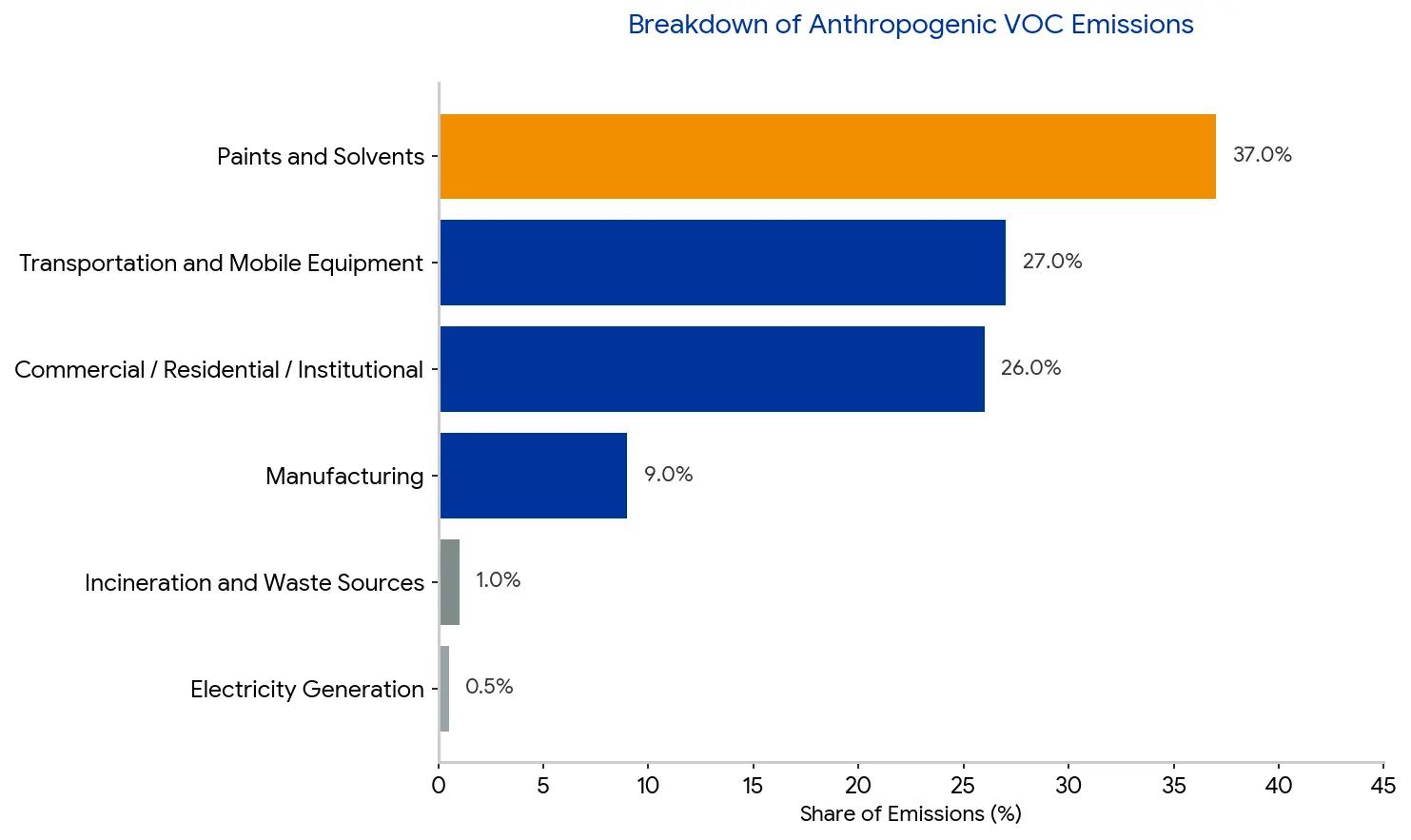
To realize the importance of these compounds, one need only look at Environment and Climate Change Canada's data for the year 2018. In urban areas, human pollution by VOCs comes from a variety of sources, but one figure strikes the mind: paints and solvents (37%) represent a more important source of pollution than transport (27%).
Government Action: Regulations and Timetable
Canada has stepped up its efforts to combat VOCs with a series of regulations targeting certain consumer products, building materials, and certain industrial sectors.
Key regulations in force
-
Volatile Organic Compound Concentration Limits for Certain Products Regulations (SOR/2021-268)
: This major regulation limit the concentration of VOCs in approximately 130 product categories (cleaners, personal care, adhesives). The limits have been in effect since January 1, 2024. -
Volatile Organic Compound (VOC) Concentration Limits for Architectural Coatings Regulations (SOR/2009-264)
: Sets limits for 53 categories of paints and varnishes. It includes seasonal restrictions for road markings to reduce summer smog. -
Volatile Organic Compound (VOC) Concentration Limits for Automotive Refinishing Products Regulations (SOR/2009-197)
: Regulates 14 categories of products used for body work to protect workers and the environment.
Timeline and future changes
The regulatory framework continues to evolve to include new sectors and strengthen existing limits:
- November 2025: Comments period ends for proposed amendments to the Automotive Refinishing Regulations.
- 2025-2032: Phased in emissions controls at petroleum facilities, aiming for an annual reduction of more than 25,000 tonnes of VOCs by 2032.
- December 31, 2027: End of validity of certain temporary compliance permits granted to companies for specific products.
For more information on the Regulations Limiting the Concentration of Volatile Organic Compounds in Certain Products, read our blog posts.
Reducing Volatile Organic Compound (VOC) Environment Emissions
Frequently Asked Questions (FAQ)
I am a simple distributor/reseller. Am I liable if the product exceeds VOC limits?
In Canada, the sale, offer for sale, manufacture, and importation are regulated. Distributors share liability. They must ensure that their suppliers provide them with guarantees of compliance. Apart from certain exceptions, all VOC regulations clearly state that it is prohibited to manufacture or import a product that exceeds the limits set out in the schedules.
What regulations govern VOCs in Canada?
At the federal level, Environment and Climate Change Canada (ECCC) enforces three distinct regulations based on the product’s end-use and target market:
- Certain Consumer and Commercial Products: Volatile Organic Compound Concentration Limits for Certain Products Regulations (SOR/2021-268). This regulation targets a wide variety of everyday and industrial products. It covers 130 categories, including deodorant, thinner or viscosity reducer for paints and cleaners.
- Architectural Coatings: Volatile Organic Compound (VOC) Concentration Limits for Architectural Coatings Regulations (SOR/2009-264). It covers 53 categories, including bituminous roof primer, clear brushing lacquer, waterproofing sealer for concrete or masonry, etc.
- Automotive Refinishing: Volatile Organic Compound (VOC) Concentration Limits for Automotive Refinishing Products Regulations (SOR/2009-197). It covers 14 categories, including primer surfacer, adhesion promoter, multicolour coating, etc.
Does the Canadian VOC Regulation apply to industrial products or only to consumer products?
The Canadian Volatile Organic Compound Concentration Limits for Certain Products Regulations (SOR/2021-268) target a wide variety of categories. Some are strictly geared toward the general public, while others impact products intended for professional, institutional, or industrial use (such as certain cleaners, degreasers, or automotive maintenance products).
How do I know which category or subcategory my product falls into?
Product categorization relies on more than just chemical composition or baseline formulation. It is largely driven by the intended use and the claims made on the label, packaging, technical documentation, or your website. Your marketing promises define your regulatory category in the eyes of Environment Canada. For example, stating on the label of an aerosol window cleaner that it is effective on other surfaces will lead to its reclassification as an all-purpose cleaner. You must then restrict its maximum VOC content to 8%, down from the initial 10%.
What happens if my product meets the definition of multiple categories?
The Strictest Category Rule: If your product’s marketing claims or instructions for use suggest it can be used for multiple applications corresponding to different categories, the lowest (most stringent) VOC concentration limit automatically applies to the entire product.
Example: Your product is a metal cleaner ideal for brakes or carburetors. Depending on its format (aerosol or non-aerosol), it must comply with the VOC limits of the following categories:
- Metal Cleansers or Polishes: 15% (Aerosol) | 3% (Non-aerosol)
- Automotive Brake Cleaners: 10%
- Carburetor or Choke Cleaners: 10%
When categories overlap, the strictest limit applies. Therefore, the maximum allowable VOC limit for your product will be 10% for an aerosol and 3% for a non-aerosol.
My products comply with US standards (EPA or CARB). Are they automatically compliant in Canada?
No. Canada drew heavy inspiration from CARB (California) and the OTC (Ozone Transport Commission), but major discrepancies exist. A product might be compliant in Canada but illegal in California or Utah due to strict local rules (such as SCAQMD for Southern California). A comprehensive re-evaluation is essential before importing or distributing in Canada.
Is it mandatory to display the VOC rate or percentage on product labels in Canada?
No. Across all three VOC regulations, Environment Canada never requires the exact or maximum VOC concentration to be displayed on the packaging. The legal obligation strictly concerns the compliance of the chemical formulation, which must remain below the maximum permitted thresholds.
However, the lack of a mandate to display the VOC rate does not mean the label can be free of regulatory text.
What are the specific requirements for VOC labelling in Canada?
In addition to meeting maximum concentration limits, products covered by Canadian VOC regulations must feature clear indications to ensure market traceability and compliance.
1. Mandatory Information on the Label
- Date of manufacture: A clear indication of the manufacturing date or a representative code.
- Responsible Party Identification: The full name and Canadian address of the manufacturer or importer.
- Official Bilingualism: Strict compliance with Canadian language requirements (English and French) for all instructions, usage statements, and dilution directions, as these directly influence product categorization.
2. Regulatory References by Product Type
Specific labelling requirements can be found in the following regulations:
- Architectural Coatings: Volatile Organic Compound (VOC) Concentration Limits for Architectural Coatings Regulations (SOR/2009-264), Section 17.
- Automotive Refinishing Products: Volatile Organic Compound (VOC) Concentration Limits for Automotive Refinishing Products Regulations (SOR/2009-197), Sections 10, 11, and 12.
- Consumer and Commercial Products: Volatile Organic Compound Concentration Limits for Certain Products Regulations (SOR/2021-268), Sections 22 and 23.
⚠️ Warning—Date Coding: If you use a complex or non-explicit coding system for the manufacture date, you must submit an explanation notice of this code to Environment and Climate Change Canada (ECCC) before placing the product on the market.
What are the risks of incorrect categorization or non-compliance?
Misinterpreting regulatory texts or having a mismatch between your formulations and marketing messages can lead to:
- Immediate non-compliance during Environment Canada inspections.
- Market recall orders across the entire Canadian territory, severely damaging your reputation and supply chain.
- Significant administrative monetary penalties (fines).
Can a product without any “VOC” mention on its packaging be inspected by Environment Canada?
Yes, absolutely. The absence of any mention of VOCs on your packaging does not exempt you from the regulations. Environment Canada inspectors conduct sampling and laboratory testing. If the tests reveal that your product exceeds the maximum allowable threshold for its category, you are in violation, regardless of what is written (or omitted) on the label.
I want to modify my formula to reduce the VOC content. What are the green solvent alternatives?
This is the ultimate challenge of substitution: reducing environmental impact without sacrificing technical performance. Here are the preferred formulation strategies:
- The use of exempt solvents: This is often the fastest solution. Certain solvents are regulatory-excluded from VOC calculations (such as acetone or dimethyl carbonate) because they have negligible photochemical reactivity. They allow you to lower your VOCs below your category’s limits while maintaining excellent efficacy.
- Co-solvent blends: Rather than replacing 100% of your solvent with a green alternative, introducing a co-solvent system creates synergies. This helps maintain the product’s original properties (flash point, hydrophilic-lipophilic balance) while bringing the overall VOC limit below regulatory thresholds.
Are there volatile compounds that are legally exempt from VOC calculations?
Yes. Several solvents are chemically VOCs, but they are regulatory-excluded (exempted) in Canada and the United States because they do not contribute to the formation of atmospheric smog.
Here is a non-exhaustive list:
- Acetone
- Methyl acetate
- Tert-butyl acetate
- Dimethyl carbonate
- Propylene carbonate
- Parachlorobenzotrifluoride (PCBTF or Oxsol 100)
- Ethane and methane
- Chlorofluorocarbon (CFC) compounds
What is the difference between a VOC limit expressed in percentage (%) and one expressed in grams per litre (g/L)?
The choice between % and g/L is determined by the applicable regulation. The Volatile Organic Compound Concentration Limits for Certain Products Regulations use % by weight. For automotive refinishing products and architectural coatings, the calculation is done in g/L (minus water and exempt compounds). Furthermore, the mathematical formula is different for each unit of measurement.
How are VOCs calculated?
The calculation of volatile organic compound (VOC) content in Canada is not uniform: it depends strictly on the federal regulation applicable to your product category.
There are two main calculation approaches: the volumetric approach and the mass approach.
- For the Automotive Refinishing Products Regulations (SOR/2009-197, s. 7) and the Architectural Coatings Regulations (SOR/2009-264), s. 12), the VOC concentration is expressed in grams per litre (g/L) of ready-to-use products. In this calculation, the volume of water and the volume of exempt compounds are generally excluded from the denominator.
- For the Certain Products Regulations (SOR/2021-268, s. 5), the VOC concentration is based on the percentage by weight (% w/w) of VOCs relative to the total weight of the product, and not on volume. When calculating the VOC content, certain volatile ingredients may be excluded from the addition if they meet the principle of a Low Vapor Pressure VOC (LVP-VOC).
What is a Low Vapor Pressure VOC (LVP-VOC)?
When calculating VOC content under the Certain Products Regulations (SOR/2021-268), certain volatile ingredients can be legally excluded if they qualify as Low Vapor Pressure VOCs (LVP-VOCs).
Because these organic compounds have an extremely low vapor pressure, they evaporate very slowly. Regulatory authorities therefore consider that they contribute negligibly to smog formation in the lower atmosphere (troposphere).
Exemption Criteria for an LVP-VOC
To be officially excluded from the % w/w VOC calculation, a compound must meet at least one of the following criteria:
- Its vapor pressure is less than 0.013 kPa (at 20 °C)
- Its boiling point is greater than 216 °C
- It is composed of more than 12 carbon atoms.

Design, programming and hosting by VisionW3.com