


Spill Management: Why Your Kit Isn’t Enough
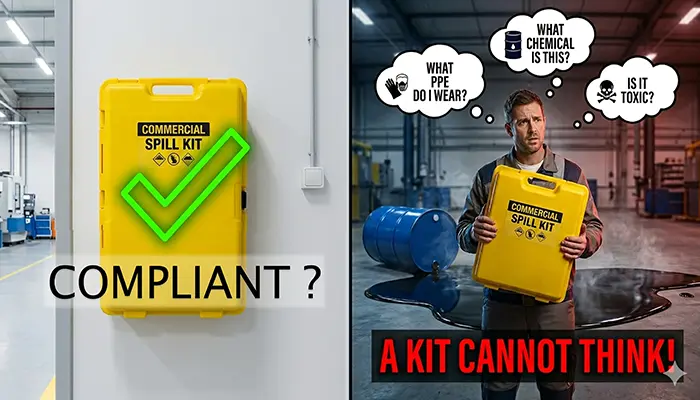
In the world of Occupational Health and Safety (OHS), there is a classic trap that many managers fall into: equipment fetishism. We install eye wash stations, purchase sophisticated masks, and, above all, mount brand-new spill kits in every strategic corner of the plant. Once the kit is installed, we check the "compliance" box on our to-do list and move on to the next file.
However, if a 200-liter drum spills tomorrow morning in your production area, that kit will be useless if the hand opening it doesn’t know exactly what to do. Even worse, without rigorous training, this kit can become a hazard by giving a false sense of competence to a well-intentioned but ill-prepared employee.
Here is why spill management is primarily a matter of people, procedures, and knowledge—long before it is a matter of equipment.
1. The Equipment Illusion: The Danger of the "Magic Box"
A spill kit is often perceived as a miracle solution. We imagine that simply throwing absorbant or socks onto a puddle will make the problem disappear. This is a major error in perspective.
The real danger during a spill isn't just the loss of product or the mess on the floor. It is the invisible chemical reaction: toxic vapors, fire risks, reactivity with surrounding materials, or skin toxicity to name a few. A spill kit does not have a brain. It cannot analyze if the escaping liquid is a strong base that will react violently with certain organic absorbents, or if the product is currently releasing a lethal gas.
When an untrained employee rushes toward the kit, they often make the fatal mistake of focusing on cleaning rather than securing. The kit is a recovery tool, not a shield of invincibility.
2. Assessment: The Pivot of the Intervention
A well-managed spill begins long before the first absorbent sock touches the ground. The first—and arguably most critical—step is the assessment of the situation. This is precisely where 4-hour training proves its worth: it transforms a moment of panic into a coordinated response.
Instead of rushing headlong into the puddle, a trained employee learns to pause and distinguish the nature of the incident. This analysis allows the event to be classified into two categories with radically different consequences:
- Minor Spill: An incident that can be safely managed internally with available resources, without an immediate threat to personnel health or large-scale environmental integrity.
- Major Spill: A critical situation that exceeds the technical capabilities of the on-site team. it presents risks of fire, explosion, or acute toxicity, requiring immediate evacuation and the call for specialized external emergency services.
The SDS as a Safety Compass
It is during this initial assessment that the Safety Data Sheet (SDS) becomes the ultimate reference tool. However, in an emergency, every second counts. A trained responder doesn’t waste time reading the SDS from top to bottom; they know exactly which strategic sections to consult to validate toxicity and choose the appropriate course of action.
Thanks to this rapid analysis skill, the employee can identify three pillars of safety:
- Immediate Dangers: Is the product highly flammable at room temperature or producing invisible vapors?
- Necessary Protection: What type of Personal Protective Equipment (PPE) is required?
- Absorbent Compatibility: Will the absorbent in your kit (whether silica or polymer-based) react dangerously with the spilled product? Do you need a neutralizer instead?
Without this rapid diagnostic capability, your kit equipment becomes useless at best, and a catalyst for danger at worst. Training ensures that the intervention is based on scientific facts rather than risky improvisation.
3. Communication and External Agencies: Knowing Who to Call
A common mistake is thinking the company must manage everything alone. Incident management includes complex legal and environmental dimensions. Training helps clarify the necessary communication chain:
- When to call 911? (Immediate risk to life or fire).
- When to contact Urgence-Environnement? (Potential impact on soil or waterways).
- What is the role of Transport Canada (CANUTEC)? For incidents involving dangerous goods.
Knowing when and how to alert these agencies cannot be improvised. It is an integral part of a robust procedure that protects the company against severe penalties and reputational damage.
4. A Custom Procedure, Not a Copy-Paste
One of the greatest strengths of specialized 4-hour training is that it doesn’t offer a "one-size-fits-all" procedure. Every company has a different reality: floor layout, proximity to drains, nature of chemicals, and hierarchical structure vary from one plant to another.
The goal is to provide managers and employees with the tools to build their own procedure. Instead of imposing a rigid framework, we teach the fundamental principles:
- Securing the premises.
- Assessment (Major vs. Minor) via the SDS.
- Alerting and communication.
- Choosing PPE and equipment.
- Containment and recovery.
Rather than performing real-world simulations (which often lead to unnecessary waste and slip hazards, even with water), the training focuses on scenarios and case studies. This allows for testing the logic of the intervention without putting anyone at risk.
5. The Arsenal: PPE and Kit Contents
Do you have the right equipment? A "standard" kit bought from a catalog isn't always adapted to your products. The training reviews the different types of Personal Protective Equipment (PPE). You don't use the same gloves for sulfuric acid as you do for hydraulic oil.
Furthermore, the training allows for a critical inventory of your current kits. Are your absorbents compatible with your products? Do you have enough socks for the volume of your largest tank? This review ensures the company has all the necessary elements for a successful intervention, avoiding nasty surprises at the fateful moment.
6. The Forgotten Step: Post-Incident Report and Analysis
Once the floor is dry and the waste is collected, spill management is not over. This is where a crucial, often neglected step comes in: the management debrief.
Training teaches the importance of writing a complete incident report. This document is not just an administrative formality; it is a continuous improvement tool that allows you to:
- Analyze Causes: Why did the spill occur? (Human error, mechanical failure, poor storage?)
- Evaluate the Intervention: Was the procedure followed? Was the equipment adequate? Was communication fluid?
- Prevent and Reduce: What measures can be put in place to ensure this doesn't happen again? Do we need to modify the physical layout or adjust the procedure?
This post-incident analysis transforms a crisis into a learning opportunity, strengthening the organization's safety culture.
Conclusion: Invest in Intelligence Rather Than the Object
Managers, your kit on the wall is a starting point, not a destination. Real compliance and the safety of your workers rest on their ability to analyze, communicate, and act according to a proven structure.
A 4-hour training session is a strategic investment. It gives your teams the autonomy to build a procedure that fits their reality, while teaching them to identify the limits of internal intervention. By valuing knowledge over simple hardware, you protect your staff, your business, and the environment for the long term.
Ready to transform your spill management?
Don't settle for a yellow box on the wall. Give your team the analytical tools they need to intervene with confidence and precision. Contact us for our custom training modules, available on-site or via videoconference.


Design, programming and hosting by VisionW3.com

