


Why Choose a Chemist for Your Safety Data Sheets (SDS)?

In the hazardous materials industry, compliance is often perceived as a mere administrative exercise. However, a Safety Data Sheet (SDS) is, first and foremost, a scientific document.
Entrusting your classifications to a seasoned chemist rather than a general safety advisor is not a luxury — it is a necessity for anyone handling complex products. Here is what defines the difference between surface-level compliance and rigorous protection.
Molecular Rigor vs. Generic Compliance: The Chemist’s Advantage
The compliance market is saturated with generalist consultants who apply safety rules by rote without always understanding their molecular origins. Where a generalist sees a regulatory obligation, a chemist sees a physical and chemical reality. This distinction is crucial when worker safety and corporate legal liability are at stake.
Toxicology & Mixture Kinetics vs. Routine Data Entry
Most generalist consultants rely on automated generation software. They input data, and the software generates a standardized result. But what happens if the reaction between two components creates an unlisted hazard or an unstable by-product?
- The Generalist: Relies on pre-existing databases, which are often incomplete for innovative formulations.
- The Chemist: Analyzes the molecular structure. They understand interactions, bonding, and potential decomposition products. This ensures the SDS reflects the physical reality of the product, not just an algorithmic approximation.
Bill 15 and the Chemists Act: A New Era of Regulated Practice
The practice of chemistry in Quebec has entered a new era. Following the passage of Bill 15 (PL15), the law strictly regulates activities that carry a risk of public prejudice. Analyzing, designing, and issuing instructions regarding molecular entities or chemical processes are now exclusive acts reserved strictly for licensed professional chemists.
What does this mean for your business? Reviewing, determining, or validating danger classifications for an SDS is no longer an administrative task that a general safety coordinator can improvise. It is a professional act of chemistry that directly binds your company’s legal liability. By entrusting your complex mixture calculations and SDS authoring to the certified team at Kalium Solutions, you ensure not only scientific accuracy but absolute compliance with Quebec’s modernized legal framework.
The Art of Toxicology and the Science of Complex Mixtures: The Chemist’s Edge in SDS Authoring
Classifying a pure product is elementary, but interpreting a complex industrial mixture is an art that requires a scientific background to master. While a generalist advisor often settles for applying generic "cut-off" rules (such as 1% or 0.1% thresholds), a chemist dives into the mechanics of the substances.
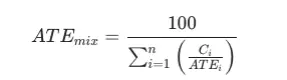
A chemistry expert doesn't just read a database; they know how to interpret LD50 (median lethal dose) studies and understand systemic penetration mechanisms. The true strength of Kalium Solutions lies in the rigorous application of additivity formulas. When multiple substances are combined, hazards don't just add up—they interact.
To determine the actual toxicity of the finished product, we use the Acute Toxicity Estimate (ATE_mix) equation:
Expert analysis makes the difference:
- Beyond Percentages: We evaluate whether components have additive, synergistic (where 1+1=3), or antagonistic effects.
- Multidimensional Precision: We calculate the ATE for ingestion, inhalation, and dermal contact, ensuring labeling that reflects the actual danger to the end user.
Did you know? A simple calculation error in mixture toxicity can turn a "non-classified" product into a "Category 3 Toxic" substance. The consequences are heavy: skyrocketing insurance premiums, draconian handling protocols, and increased legal risks. A chemist's expertise protects both your employees' health and your company's financial health.
Precision in Complex Mixture Calculations
When you mix several substances, physical properties change: flash point, pH, viscosity, and vapor pressure.
- A chemist masters the laws of thermodynamics and intermolecular interactions.
- They can predict if an additive will radically alter the flammability or reactivity of a solution, ensuring surgical precision where software might fail to detect a significant change.
Kalium Solutions: Scientific Expertise at the Service of Your Compliance
When a company seeks a hazardous materials consultant, they are looking to eliminate uncertainty. Kalium Solutions stands out through its team of chemists, which is vital for the accuracy of chemical classifications.
Our approach goes beyond simple data entry. We integrate science at the core of your compliance strategy for WHMIS 2015 and GHS. By directly linking laboratory expertise to regulatory requirements, we offer peace of mind that only scientists can guarantee.
The Risks of Inaccurate SDS Classification
An erroneous SDS is a major financial and human risk.
- Under-classification: Exposes your employees to unreported hazards and your company to criminal prosecution and fines from regulatory bodies (like CNESST or OSHA).
- Over-classification: Leads to unnecessarily high transport costs (hazardous goods), storage requirements, and insurance premiums.
A chemist’s eye allows for precise calibration, optimizing your operations while protecting your assets.
Conclusion: Science as a Guarantee of Safety
Don't leave your safety in the hands of generalists or simple software. For your Safety Data Sheets to be true protection tools, they must be authored by those who understand the matter. With Kalium Solutions, your SDS are not just compliant—they are scientifically accurate.
Need to validate the accuracy of your current SDS?
FAQs About WHMIS
Why isn't SDS generation software enough?
While software tools are useful, they cannot interpret the nuances of complex chemical reactions or synergies between components. A chemist’s eye at Kalium Solutions is essential to validate data, correct algorithmic errors, and ensure the classification reflects the product's scientific reality.
What is the difference between a safety advisor and a chemist for SDS authoring?
A generalist advisor often focuses on the administrative side of compliance. Conversely, a chemist possesses deep expertise in toxicology, thermodynamics, and chemical kinetics. This scientific rigor allows for more precise classification, avoiding costs related to mismanaged hazard classes.
How does Kalium Solutions guarantee the accuracy of chemical classifications?
Kalium Solutions distinguishes itself through a team of chemists who analyze every ingredient at the molecular level. We perform rigorous mixture calculations and interpret toxicological studies (LD50, LC50) to ensure every SDS is not only WHMIS 2015/GHS compliant but technically flawless.
Can poor SDS classification have financial impacts?
Absolutely. Under-classification increases the risk of accidents and legal penalties, while over-classification can lead to unnecessarily high shipping, storage, and insurance costs. Hiring an expert chemist optimizes these costs by achieving the exact classification.


Design, programming and hosting by VisionW3.com

