


TDG Regulations SOR/2026-112 & 127: Analysis and Compliance Guide by Our Expert Chemists
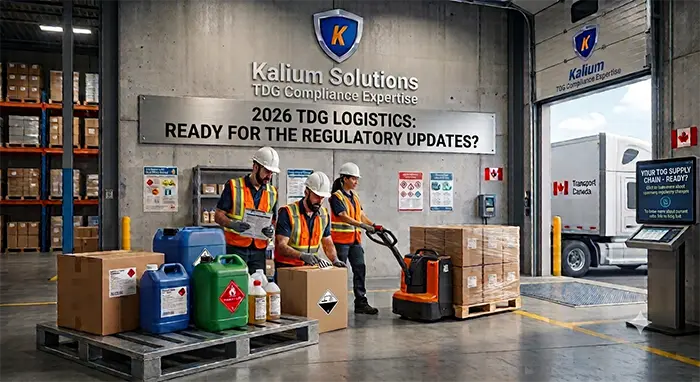
The Transportation of Dangerous Goods (TDG) is an essential pillar of the Canadian economy, but it is also a field where public safety and regulatory compliance represent an ongoing challenge. If you work in logistics, transport, or supply chain management, you know how quickly this legal framework can evolve.
To adapt to today's technological and industrial realities, the Government of Canada regularly makes legislative adjustments. Recently, two major pieces were added to the regulatory puzzle in the Canada Gazette:
- Regulations SOR/2026-112, which primarily target Part 12 and mark a major milestone for international harmonization;
- Regulations SOR/2026-127, officially published on July 1, 2026, which consolidate these regulatory amendments.
Together, these texts bring crucial changes to the Transportation of Dangerous Goods Regulations (TDGR).
What do these changes mean for your business, shipping procedures, and carrier compliance?
Our team of expert chemists at Kalium Solutions breaks down this major Canadian regulatory update and provides a clear roadmap to keep your operations compliant.
Part 12 Reform: Air Transport of Dangerous Goods Goes Digital
If you ship by air, Part 12 of the regulations has received a major refresh. The previous rules were becoming outdated and no longer reflected modern aviation realities.
Monthly Electronic Reporting for Undeclared Goods and ICAO Alignment
- Undeclared or Misdeclared Dangerous Goods Incident Reporting: Carrier reports are shifting to a monthly electronic format, replacing immediate phone reporting. This data collection aims to identify risk trends among passengers and better target awareness and prevention initiatives.
- Harmonization with ICAO: Transport Canada is aligning its rules with the Technical Instructions of the International Civil Aviation Organization (ICAO), eliminating several distinct Canadian air exemptions. This harmonization clarifies the transport of essential dangerous goods on board (first aid kits, scientific equipment, heavy medical supplies). It eliminates regulatory ambiguity that previously forced carriers to reject critical shipments or require redundant special permits for products already approved internationally.
Streamlined Rules for Remote Areas and Emergency Aerial Work
Limited Access Areas: Clarification of Requirements (SOR/2026-112)
Transporting dangerous goods to remote communities and northern worksites is a strategic imperative. The regulatory update introduces pragmatic adjustments:
- Strict Definition of Essential Cargo: Clear framework for transporting fuel, medical supplies, and survival resources.
- Targeted Flexibilities: Adapted packaging and handling requirements when no alternative surface transport exists.
- Operational Continuity: Maintaining vital supply lines for northern regions without imposing bureaucracy that conflicts with operational realities.
Wildfire Management: Rules Adapted for Emergency Aerial Work (SOR/2026-112)
In the face of climate emergencies, suppression operations require maximum agility without compromising crew safety.
- Emergency Response Products Framework: Clarified rules for on-board transport of critical materials (pyrotechnic products for backburns, fire retardants, emergency fuels).
- Operational Agility: Administrative relief to allow rapid deployment during forest fires.
- Enhanced Safety: Clear guidelines established to protect pilots, flight crews, and ground support personnel.
Transport of Lithium Cells and Batteries: Strict New Requirements (Class 9)
Classified as Class 9 dangerous goods, lithium batteries remain a major logistical challenge due to thermal runaway risks. The updated regulations adjust to tech industry realities:
Removal of Phone Number Requirement on Lithium Battery Mark
The identification mark for lithium batteries is changing. Transport Canada has removed the requirement to display an emergency telephone number. This simplification aligns visuals with international standards and reduces the labeling burden for your shipments.
30% State of Charge (SoC) Limit for Air Transport
To align with ICAO and IATA requirements, the State of Charge (SoC) for lithium-ion batteries shipped on passenger aircraft is now capped at 30% of their rated capacity. This restriction aims to significantly reduce the risk and intensity of thermal runaway incidents in cargo holds.
Modernization of TDG Packaging: Repeal of Outdated Standards and New Frameworks
Transport Canada is overhauling its normative frameworks governing the manufacturing, selection, and use of containers. Because dangerous goods transport relies on numerous industry standards (CGSB, ASTM, military specifications), the new regulations harmonize these frameworks to integrate modern protocols.
⚠️ Compliance Alert: Repeal of Obsolete Standards
To simplify and clarify the regulatory framework, several obsolete definitions and references are officially repealed (notably certain military standards and specifications ASTM F 852, TP 14850, CAN/CGSB-43.126, and TP 14877).
This update relies on revised terminology—such as the UN Manual of Tests and Criteria—and clarified fundamental definitions. For example, terms like "in," "by," or "on board" are now legal equivalents when referring to aircraft, marine vessels, road vehicles, or railway cars.
Entry into Force of New CGSB Standards
The regulations officially incorporate the latest versions of the Canadian General Standards Board (CGSB) national standards. Four key standards now redefine compliance:
- CAN/CGSB-43.150: Officially enters into force, permanently replacing TP 14850 and CAN/CGSB-43.126, consolidating previously scattered requirements under a single framework.
- CGSB-43.145: Governs technical specifications for UN standardized large packagings. It provides precise directives regarding packagings reuse and the management of partially filled packagings.
- CAN/CGSB-43.147: Regulates safety requirements for railway tank cars and dangerous goods packagings.
- CAN/CGSB-43.149: Covers ton containers (commonly used for transporting liquefied gases and industrial chemicals).
Why Packaging Harmonization Matters for Your Business
Aligning with these new standards ensures that containers used across road, rail, marine, and air transport meet the latest mechanical strength and leak-tightness requirements. This transition presents an excellent opportunity to audit your means of containement suppliers' certifications and update your internal packaging procedures.
Modernization of Schedules 1 and 2: Updating the Dangerous Goods List
Schedules 1 and 2 represent the technical core of daily TDG management, containing UN numbers, proper shipping names, and special provisions. The regulations bring significant adjustments to these references:
- UN Number Updates: New entries appear to cover recent chemical and technological innovations, while obsolete numbers have been removed to streamline classification.
- Revision of Special Provisions (Schedule 2): Several special provisions have been rewritten to align directly with Special Provisions in the UN Model Regulations, affecting transport conditions for unstable substances, gases, and limited quantity shipments.
Cross-Border Harmonization: Greater Flexibility with US 49 CFR
A central goal of this regulatory update is to reduce logistical friction for businesses engaged in cross-border trade. Canada is aligning its requirements more closely with major international standards—including UN Recommendations ("Orange Book"), the IMDG Code (maritime), ICAO Technical Instructions (air), and US 49 CFR.
This alignment brings welcome operational flexibility for fleet managers and compliance officers.
Expanded Recognition of Special Permits and US Labeling
- Recognition of 49 CFR Special Permits: The text clarifies and expands automatic recognition of US Special Permits for initial cross-border shipments. Shippers must follow the permit's safety conditions and clearly indicate its reference on the shipping document (e.g., "DOT-SP XXXXX").
- Toxic by Inhalation Hazard Placards and Labels: US placards, labels, and shipping descriptions for inhalation hazards are now fully recognized in Canada for cross-border transport (inbound and outbound). This eliminates the need to relabel products or layer Canadian placards at the border.
Bilingualism and Official Terminology: Adoption of "UN Number"
- Harmonization of "UN Number" in French: To eliminate ambiguity during inspections or manifest processing, the regulations clarify that using "numéro UN" or "UN number" meets official legal requirements across incorporated documents.
- Text on Labels and Placards: Required regulatory safety terms can now formally be displayed inside labels or placards in either French OR English.
- Documentary Flexibility: For text other than proper shipping names required on shipping documents, capitalization, lowercasing, spelling, or punctuation can follow US 49 CFR or UN formats. This provides significant relief for integrated North American supply chains.
New Dimensions and Visual Integration of UN Numbers on Labels
Visual risk identification is vital for first responder safety during an incident. The regulations bring two key clarifications:
- Alignment with UN Standards: The text explicitly details correspondences between Part 4 requirements and UN Recommendations illustrations.
- Integration of UN Numbers on Labels: Displaying UN numbers directly inside hazard labels (within a rectangular box, similar to placards) is now permitted.
- Regulated Dimensions for Small Means of Containment: Display sizes for UN numbers on small containers are now strictly regulated and aligned with IMDG Code and ICAO Technical Instructions requirements.
Regulatory Relief: Revised Mass Exemptions and Limited Quantities
The TDGR provides essential exemptions to reduce administrative burdens for businesses transporting small volumes of dangerous goods (propane cylinders, paints, etc.). The update restructures these mechanisms for easier field application.
Clarification of 150 kg and 500 kg Gross Mass Exemptions
The wording of gross mass exemptions has been clarified to eliminate ambiguity during roadside inspections:
- 150 kg Exemption: The text explicitly specifies which parts of the regulations are exempt (notably shipping document and hazard mark requirements), securing compliance for end users.
- 500 kg Exemption: Eligibility criteria are reworded under the same simplification approach to ensure greater operational predictability.
New Marking Rules for Limited Quantity Shipments
Transport in "limited quantities"—covering packaging intended, among other things, for retail sale (aerosols, disinfectants, etc.)—undergoes technical adjustments in subsection 1.17(2):
- Durable and Legible Marking: The requirement for durable, clear marking on one side of the container is reinforced.
- Mandatory Placement (Prohibited on Top and Bottom): The limited quantity mark must no longer be placed on the top or bottom of the packaging.
- Operational Objective: Allows handlers and emergency personnel to instantly spot limited quantity markings even when packages are stacked on pallets.
Action Plan: Adapting Your Operations to the 2026 Regulations
The adoption of SOR/2026-112 and SOR/2026-127 confirms Transport Canada's commitment to maintaining a modern, agile regulatory framework aligned with international standards. By clarifying language and integrating rigorous technical standards, these updates strengthen supply chain safety while adapting to carrier realities.
In dangerous goods management, non-compliance carries heavy risks: a missing placard, expired container, misplaced mark, or incorrect UN number can quickly lead to rejected loads, border delays, and major fines.
Your Compliance Roadmap
1. Audit Packaging Protocols (Procurement Priority): Review container supplier certifications. Validate compliance with new CGSB standards (CAN/CGSB-43.150, 43.145, 43.147, and 43.149).
2. Update ERP Systems & TDG Software (IT & Logistics Priority): Integrate typographic flexibilities, automatic recognition of international formats (49 CFR, DOT-SP), and official terminology updates.
3. Train Personnel and Shippers (OHS & Operations Priority): Adapt training programs to new exemption rules (150 kg, 500 kg) and mandatory limited quantity mark placement.
4. Optimize Cross-Border Flows (Transport & Customs Priority): Brief dispatchers and safety advisors on full recognition of US special permits and inhalation hazard markings.
💡 Official Resources: To consult full legislative texts, Regulatory Impact Analysis Statements (RIAS), and complete lists of amendments, visit the Canada Gazette.
Ensure Team Compliance with Our TDG Training Programs
The entry into force of Regulations SOR/2026-112 and SOR/2026-127 requires updated knowledge across the supply chain, but the actual impact varies by company. If your operations involve revised CGSB packaging standards, cross-border shipping, limited quantity marking, or lithium batteries, targeted skill updates are essential to maintain compliance and avoid costly delays.
At Kalium Solutions, our chemists and regulatory compliance experts deliver official and customized TDG training, available in-person or via live synchronous videoconferencing. Our programs incorporate all the requirements of the new 2026 amendments (SOR/2026-112 and 127) to ensure the legal qualification and certification of your personnel.
🎓 Take action: Update your team’s expertise and secure your shipments by exploring our full TDG training program.
💬 Discussion & Expert Support
How are these regulatory updates impacting your internal processes?
If you want to validate the exact impact of these decrees on your packaging, shipping documents, or team training needs, contact our team at Kalium Solutions to schedule a compliance audit and secure your operations today.


Design, programming and hosting by VisionW3.com

