
CEPA Compliance: Canadian New Substances Notification (NSN) & SNAc Guide
Planning to import or manufacture a chemical substance in Canada? Before launching your product, you must answer one critical regulatory question: is your substance considered "new" under Canadian law? If it is absent from the Domestic Substances List (DSL), strict compliance mandates apply under the Canadian Environmental Protection Act (CEPA). This expert guide breaks down your specific notification requirements, helps you calculate reporting thresholds, and navigates the complex ECCC and Health Canada schedules to secure your market access.
What Is a New Substance Under the Canadian Environmental Protection Act (CEPA)?
Under CEPA, a substance is considered new in Canada when it is not listed on the Domestic Substances List (DSL).
Any substance absent from the DSL is presumed new and must be assessed before being imported or manufactured in Canada beyond the prescribed thresholds.
Navigating the Domestic Substances List (DSL) and Critical Notations
Substances on the DSL may carry up to five different notations. Three notations indicate additional obligations:
- Notation "S": Significant New Activity (SNAc) provisions apply to this substance individually.
- Notation "S'": Significant New Activity provisions apply to a group of substances.
- Notation "P": Applies to polymers meeting the criteria for Reduced Regulatory Requirements (RRR). A form that does not meet RRR criteria must be the subject of a New Substance Notification (NSN).
These notations are detailed in the decision flowchart below.
Understanding the Non-Domestic Substances List (NDSL) Requirements
The NDSL is an inventory of more than 50,000 chemical substances and polymers that are not in commerce in Canada above threshold quantities, but are commercially available outside Canada — primarily based on the U.S. TSCA inventory.
Substances on the NDSL are considered new in Canada and are therefore subject to the notification requirements of the New Substances Regulations (NSR). However, the information requirements are less extensive than those for substances on neither list, and the triggering thresholds are higher.
To verify the status of your substance, use the Substance Search tool on the Environment and Climate Change Canada (ECCC) website.
When and How to Submit a New Substance Notification (NSN)
The New Substance Notification (NSN) is the mechanism by which ECCC and Health Canada jointly assess the risks of a new substance before it enters the Canadian market.
Who is Obligated to File an NSN Report with Health Canada and ECCC?
Under Canadian environmental law, any individual or corporation planning to manufacture or import a new substance into Canada must submit a New Substance Notification (NSN). This mandatory regulatory filing applies to chemical substances, polymers, and living organisms. Your legal obligation is triggered the moment your projected annual volume exceeds the strict regulatory thresholds defined by the applicable CEPA reporting schedule.
NDSL Notification Thresholds and Reporting Schedules (Schedules 4, 5, 9 & 10)
Substances on the NDSL benefit from a higher entry threshold. The applicable schedules (4 and 5 for chemical substances, 9 and 10 for polymers) require less data than for substances on neither list.
|
Threshold (kg/year) |
Notice Period |
Schedule (chemical / polymer) |
|---|---|---|
|
< 1,000 |
No notification required |
— |
|
1,000 to 10,000 |
30 days before |
4 / 9 |
|
> 10,000 |
60 days before |
5 / 10 |
|
> 50,000 |
75 days before (60 days for polymers) |
5 / 10 + suppl. data |
* The 75-day notice period and supplemental data apply when aquatic releases exceed 3 kg/day or when public exposure is elevated.
NSN Thresholds for Unlisted Substances (Schedules 4 to 6 & 11)
Substances absent from both lists are subject to the most extensive requirements. The entry threshold is 100 kg/year for chemical substances, and the applicable schedules (4 to 6 for chemicals, 9 and 11 for polymers) require more substantial data.
|
Threshold (kg/year) |
Notice Period |
Schedule (chemical / polymer) |
|---|---|---|
|
< 100 kg/year |
No notification required |
— |
|
100 to 1,000 kg |
5 days before |
4 |
|
1,000 to 10,000 kg |
60 days before |
5 / 9 |
|
> 10,000 kg |
75 days before |
6 / — |
|
> 10,000 kg |
60 days before |
— / 11 |
Knowing your NSN notification obligations is only part of the picture. Even when a substance is already listed on the DSL and no NSN is required, it may be subject to a distinct regulatory mechanism: the Significant New Activity (SNAc) notice.
Significant New Activity (SNAc) Notices: Obligations for Existing Substances
The Significant New Activity (SNAc) notice applies to substances already listed on the DSL when a new use could generate a risk not assessed previously. Additionally, an NSN assessment can directly lead to an SNAc: even if the initially proposed use poses no risk, a different use might. ECCC or Health Canada will then publish a notice or order in the Canada Gazette if this new activity could render the substance toxic under section 64 of CEPA.
How to Verify if a Chemical Substance Carries a SNAc Notice
Several resources can be used to verify whether a substance is subject to an SNAc:
- The DSL itself: look for notations "S" or "S'" next to the substance identification number in Part 2 of the list.
- The SNAc publications directory: ECCC maintains a complete list of substances subject to Significant New Activity provisions.
- The Canada Gazette: the official source for all SNAc notices and orders currently in force.
Mandatory Information Requirements and Filing When a SNAc Applies
Requirements vary from one notice or order to another, there is no standard form for SNAc submissions. The notice published in the Canada Gazette specifies: the definition of the new activity, the required information (quantities, intended uses, toxicological data, release information), and the assessment period granted to the government (generally 90, 120, or 180 days.
Critical CEPA Schedule 2 Exclusions (Pesticides, Fertilizers, and Feeds)
SNAc provisions do not apply to substances used in sectors regulated by other federal acts listed in Schedule 2 of CEPA, such as the Pest Control Products Act, the Fertilizers Act, or the Feeds Act.
Step-by-Step Guide: Navigating Canadian Regulatory Lists and Schedules
The ECCC Guidance Document for the NSR (chemical substances and polymers) contains detailed decision flowcharts to guide schedule selection. To simplify your search, our experts have developed a complete decision flowchart to help you determine the applicable schedule and the obligations that follow.
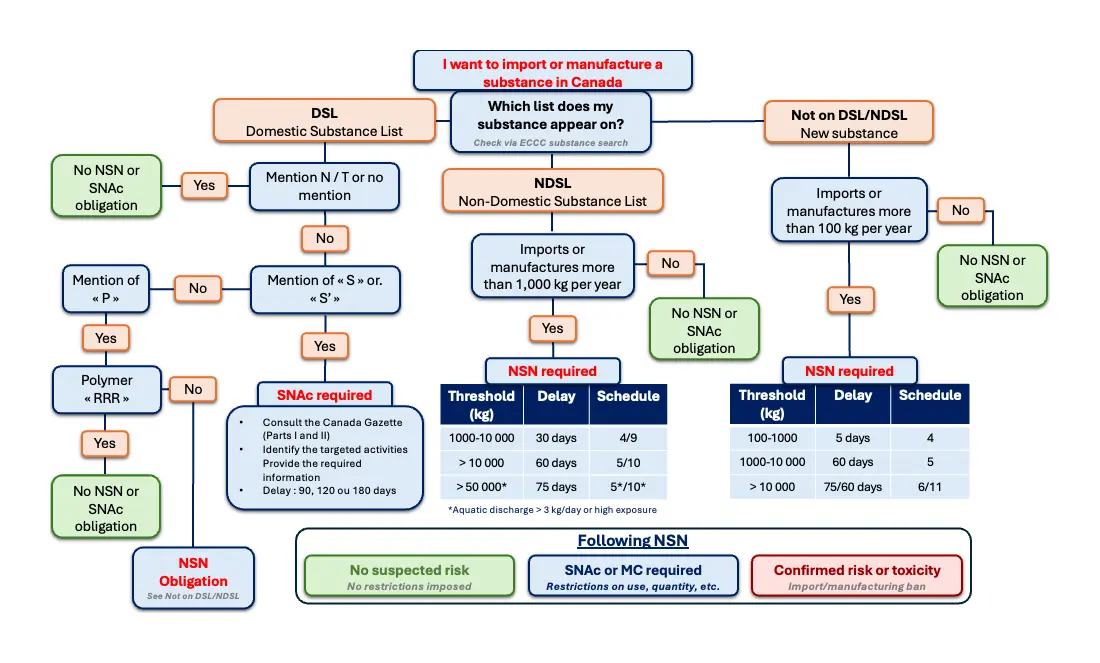
Step 1: Verifying DSL and NDSL Status via ECCC Substance Search
Start by consulting the ECCC Substance Search. Enter the CAS number, NIC, or chemical name of your substance.
Scenario A: Substance is Listed on the DSL (Checking for SNAc Notations)
Check the associated regulatory notations. Notation "S" or "S'" means an SNAc is in effect. Consult the Canada Gazette to identify the targeted activities and specific requirements.
Scenario B: Substance is Listed on the NDSL (Reduced Notification Track)
New substance in Canada with reduced requirements. Proceed to Step 2 to determine whether an NSN is required based on your projected volumes.
Scenario C: Substance is Absent from Both Lists (Full New Substance Notification Required)
Considered new in Canada with full requirements. Proceed to Step 2 to determine whether an NSN is required based on your projected volumes.
Step 2: Calculating Annual Quantities to Determine NSN Thresholds
If your substance is new (absent from the DSL), estimate the annual quantities you plan to import or manufacture. Compare these quantities to the thresholds in the tables above to determine the applicable schedule and the notice period to observe.
Critical Rules for Accurate CEPA Threshold Calculations
- No "Free Riding" on Existing Notifications: Thresholds apply to each notifier individually. Even if a competitor or another market player has already notified the exact same substance, your legal obligation to file an NSN remains entirely unchanged.
- Calendar-Year Tracking: Regulatory quantities must be calculated on a strict annual basis (January 1 to December 31 of each calendar year), not on a rolling 12-month period.
- Strategic Compliance Support: Determining the correct schedule requires deep technical and legal analysis. If you are unsure which regulatory path applies to your volumes, contact the Kalium Solutions expert team to secure your market entry.
Step 3: Assessing and Confirming SNAc Compliance Requirements
Even if your substance is on the DSL and no NSN is required, always check whether it carries an SNAc notation before commercializing it for a new use. If an SNAc order is in effect, the prescribed information must be submitted with enough lead time for the government to complete its assessment before the activity begins.
Expert Support for Your CEPA, NSN, and SNAc Compliance
Unsure about your substance’s regulatory status or which CEPA schedule applies? Chemical compliance can be complex, and structural errors can lead to costly customs delays or penalties. Our team of senior chemists provides expert guidance throughout your entire compliance process. For any questions regarding your NSN tracking or SNAc obligations,

Design, programming and hosting by VisionW3.com