


WHMIS Compliance Guide: Requirements for SDSs and Labels
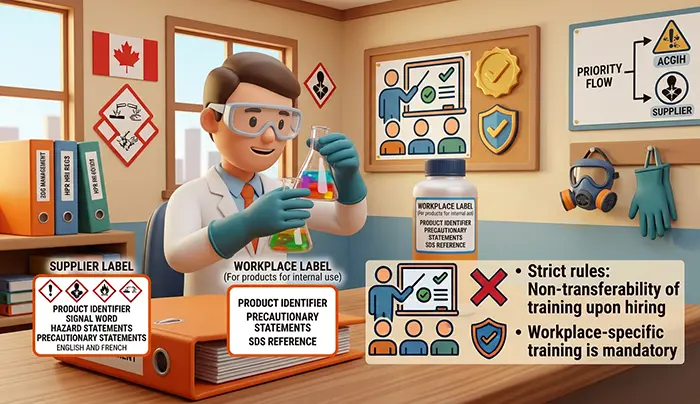
WHMIS Guide: SDS Compliance, Labeling, and HPR Regulations in Canada
If you are new to the regulations or wish to refresh your understanding of the framework's fundamentals, we invite you to first consult our overview article: What is WHMIS?. This guide specifically targets employers, EHS managers, and compliance leads responsible for managing the day-to-day regulatory alignment of their safety data sheets (SDS) and workplace labels. To take compliance a step further and ensure your entire workforce is properly trained, explore our tailored WHMIS training courses, designed to meet the concrete requirements of CNESST and the Hazardous Products Information Regulations (HPIR).
In Canada, the sale, importation, and use of hazardous chemical products are strictly governed by the Hazardous Products Regulations (HPR), the Hazardous Products Act (HPA), and provincial regulations such as the Hazardous Products Information Regulation (HPIR) under the Act respecting occupational health and safety (OSHA) in Quebec.
Because the transition period granted to integrate the GHS regulatory amendments (7th and 8th revised editions) ended in December 2025, all Safety Data Sheets (SDSs) and labels must imperatively comply with the regulations currently in force.
Here is a detailed analysis / WHMIS guide from our experts addressing the most frequent technical questions.
1. Foreign SDSs and Importation: Compliance in Section 1
Can foreign supplier information be kept on an SDS in Canada?
Short answer: No, not for a product intended for resale or distribution.
According to the Hazardous Products Regulations (HPR), Section 1 of an SDS distributed in Canada must display an "initial supplier identifier" residing in Canada (name, full mailing address, and phone number).
| COMPLIANCE MATRIX: SUPPLIER IN SECTION 1 | ||
| COMPANY SITUATION | HPR REQUIREMENTS | |
| Sale, resale, or distribution in Canada | --> | Canadian importer address |
| Direct import for internal use (Sec. 5.9) | --> | Foreign supplier address |
1. Products Sold or Distributed in Canada (General Rule)
- Obligation: You must modify Section 1 to enter the contact information of the Canadian importer or local distributor. It is illegal to provide a customer with an SDS containing only foreign contact details (United States, Europe, Asia).
- Coexistence Allowed: The original foreign manufacturer's contact details may be retained, provided that the Canadian party is clearly identified as the initial supplier/importer.
2. Direct Importation for Exclusive Internal Use (Exemption under HPR Sec. 5.9)
- Granted Right: If your company imports a chemical product strictly for its own internal use within its facilities (without any resale or distribution to third parties), Section 5.9 of the HPR authorizes you to retain the foreign supplier's contact information in Section 1.
- Expert Warning: This exemption applies only to the supplier's contact details. The employer remains legally responsible for ensuring the remainder of the document is fully compliant (bilingual French/English format, Canadian classifications, and applicable exposure values).
Can a European SDS (REACH/CLP) be used in Canada?
Short answer: No. An SDS designed under the European REACH/CLP regulations does not comply with Canadian law.
Although the Globally Harmonized System (GHS) provides a common international framework, major legislative differences remain:
- Section 1 (Identification): Absence of the legally responsible Canadian importer details.
- Section 8 (Exposure Limits): European regulatory values (OELs) are not recognized in Canada and must be replaced with provincial standards and ACGIH guidelines.
- Section 15 (Regulatory Information): Absence of references to the HPA and HPR.
What Kalium Solutions does for you: Our experts and chemists adapt and rewrite your foreign-sourced SDSs through our turnkey SDS authoring service to convert them into compliant documents meeting Health Canada and CNESST requirements. If you prefer to manage conversions internally, you can rely on our SDS authoring and management software to rapidly generate compliant, bilingual Canadian sheets adhering to current regulations, including the latest updates.
2. Occupational Exposure Limits (Section 8)
Which Occupational Exposure Limits (OELs) should be listed in Section 8 of a Canadian SDS?
In Canada, occupational exposure limits fall primarily under provincial and territorial jurisdiction. When authoring a Canadian SDS, selecting Section 8 data follows a strict legal priority cascade:
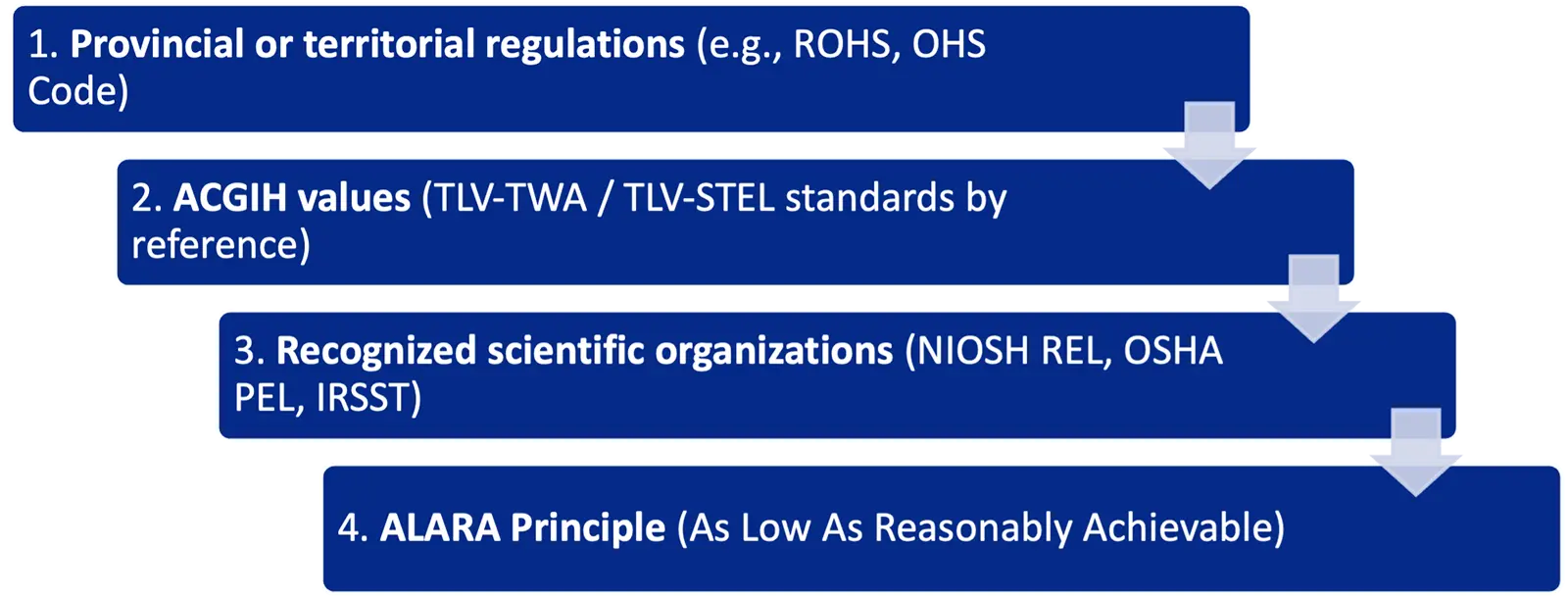
Priority 1: Destination Province Regulations
List the limits established by applicable provincial legislation first:
- Quebec Example: The TWA (Time-Weighted Average Exposure Value) and STEV (Short-Term Exposure Value) prescribed by the ROHS (Regulation respecting occupational health and safety).
- Alberta Example: The OHS Code (Occupational Health and Safety Code).
Priority 2: ACGIH Standards (Regulatory Incorporation by Reference)
If a province has not set a value for a specific substance, the majority of provincial jurisdictions incorporate the recommendations of the ACGIH (American Conference of Governmental Industrial Hygienists) by reference. The current TLV-TWA (Threshold Limit Value - Time-Weighted Average) and TLV-STEL (Threshold Limit Value - Short-Term Exposure Limit) values then become the legal requirement.
Special Case: Federally Regulated Businesses (COHSR)
For organizations under federal jurisdiction (interprovincial transport, airports, telecommunications, banks), section 10.19(1) of the Canada Occupational Health and Safety Regulations (COHSR) mandates compliance exclusively with the most recent TLV values published by the ACGIH.
Priority 3 & 4: Absence of Legal Limits: Scientific References and ALARA Principle
When no value is specified by law or the ACGIH, the employer must exercise due diligence and limit exposure to the lowest reasonably achievable level under the ALARA (As Low As Reasonably Achievable) principle. Scientific and recognized technical recommendations should then be referenced:
- NIOSH (National Institute for Occupational Safety and Health) and its RELs (Recommended Exposure Limits);
- OSHA (Occupational Safety and Health Administration) and its PELs (Permissible Exposure Limits);
- Technical and scientific guides from IRSST (Institut de recherche Robert-Sauvé en santé et en sécurité du travail in Quebec).
3. Supplier Labeling vs. Workplace Labeling
Labeling Requirements Comparison Table
| Compliance Criterion | Supplier Label | Workplace Label |
|---|---|---|
| Legally Responsible Party | Manufacturer, importer, or distributor | Employer |
| Trigger Event | Prior to the product entering the facility | Decanting, illegible original label, internal production |
| Language | Mandatory bilingual (French/English) | Official workplace language(s) (e.g., Quebec requires French) |
| Number of Elements | 6 regulatory elements (HPR Sec. 3(1)) | 3 mandatory elements (HPIR Sec. 7) |
Label Elements:
- Supplier Label (6 elements): Product identifier (name), initial supplier identifier, hazard pictograms, signal word, hazard statements, precautionary statements.
- Workplace Label (3 elements): Product identifier (name—identical to the SDS), precautionary statements, explicit reference to consult the SDS.
When is a workplace label mandatory?
Under hazardous products regulations (HPIR in Quebec), a workplace label is legally required in 3 situations:
- Decanting: Transferring a substance from an original container into a secondary container (e.g., spray bottle, shop jug).
- Deficient Original Label: A supplier label that has peeled off, been obscured, stained, or become illegible.
- On-Site Production: A hazardous mixture or product manufactured directly by the company for internal operations.
Immediate Use Exemption (HPIR Sec. 13):
A workplace label is not mandatory during decanting if and only if:
- The product remains under the exclusive control of the person who performed the decanting; AND
- The entirety of the product is consumed during the same work shift.
If the container is left unattended (even during a break) or if product remains for the next shift, labeling becomes immediately mandatory.
Can a supplier label be reproduced for decanted products?
Yes. It is fully compliant to reproduce (via color printing or photocopying) the original supplier label to affix to a secondary container. Although it exceeds the 3-element minimum required for workplace labels, it offers maximum safety, provided the print remains exact to the original and fully legible.
Why label non-hazardous contents?
An unlabeled container creates immediate ambiguity in the workplace. Clearly identifying non-regulated substances (demineralized water, food-grade oil) eliminates doubt, prevents handling errors, and avoids non-compliance notices during health and safety inspections (such as by the CNESST).
4. Validity Period of SDSs in Canada
What is the validity period of an SDS in Canada?
Since the implementation of WHMIS 2015 and its 2022 update, the automatic 3-year expiration rule no longer exists for the majority of provincially regulated businesses.
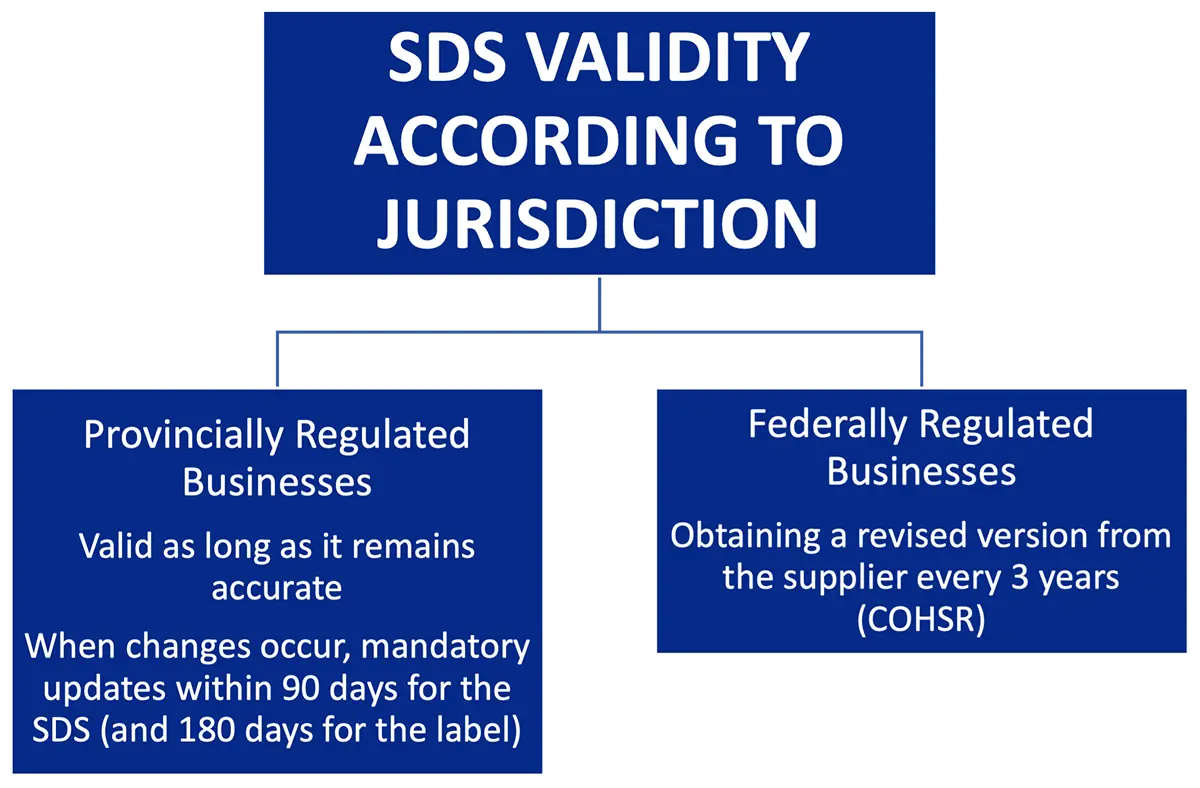
1. General Provincial Rule (Continuous Update - HPA Sec. 14.3):
The SDS remains valid as long as no significant new data is issued. Suppliers have 90 days to update the SDS (and 180 days for the label) following a change in formulation, the emergence of new toxicological data, or a regulatory revision (HPR Sec. 5.12).
2. Exception for the Federal Sector (COHSR Sec. 10.32):
Businesses under federal jurisdiction must imperatively renew their SDSs from their suppliers at least every 3 years.
3. 2026 Enforcement Status (WHMIS 2015 Revision 2022):
With the transition period ending in December 2025, any SDS based exclusively on pre-December 2022 criteria is considered outdated and non-compliant. Your SDSs must include new hazard categories (aerosols, flammable gases, combustible dusts).
To learn about all changes, read our blog post: Important Update on WHMIS.
5. WHMIS Training Obligations
Is a WHMIS certificate transferable to a new employer?
No. The legal responsibility for training is non-transferable.
Under Section 32 of the HPIR and Section 62 of the OSHA in Quebec (and equivalent directives in other provinces), a new employer cannot simply file a certificate issued by a former employer or external organization.
Part 1: Theoretical Training (General):
If the employee holds a certificate, the new employer has a legal duty to verify and validate their knowledge (via a questionnaire or internal evaluation). In case of failure or uncertainty, the theoretical training must be retaken.
Part 2: Practical Training (Workplace-Specific):
Strictly mandatory with every new hire. The new employer must train the worker on:
- The exact list of chemical products handled in the facility;
- The physical and digital locations of the workplace SDSs;
- Emergency, first-aid, and spill management procedures;
- Required Personal Protective Equipment (PPE).
Bring Your Company into Compliance with Kalium Solutions
Do you have doubts about the compliance of your Safety Data Sheets (SDSs), labels, or the structure of your WHMIS training program?
Our regulatory experts and chemists can perform a complete audit of your inventory and author customized documents tailored to your needs.


Design, programming and hosting by VisionW3.com

